

Quick answer: Our top pick in this guide to the best bike tire levers and co2 inflators (2026) is the Park Tool TL-1.2 Lever Set at $7 (overall levers). The runner-up is the Pedro’s Tire Levers at $8. The table below compares all picks by price and who each is best for.
The best bike tire levers turn a roadside flat from a struggle into a two-minute job, and a compact CO2 inflator gets you back to pressure in seconds instead of hundreds of pump strokes. These are small, cheap tools, but the wrong ones snap, scratch rims or waste cartridges. We compared the proven lever sets and the inflators riders actually carry to find the combos worth putting in your seat bag.
Disclosure: This article contains links to products on Amazon. If you buy through these links, we may earn a small commission at no extra cost to you.
Related guide: how to fix a flat bike tire.
Related guide: bike pre-ride safety check.
Quick picks
| Tool | Best for | Type | Price (approx.) |
|---|---|---|---|
| Park Tool TL-1.2 Lever Set | Overall levers | Nylon levers, set of 3 | $7 |
| Pedro’s Tire Levers | Tight tires | Nylon levers, pair | $8 |
| Lezyne Matrix Levers | Durability | Composite levers | $10 |
| Crankbrothers Speedier Lever | Stubborn beads | Single knuckle-saver lever | $9 |
| PRO BIKE TOOL CO2 Inflator | Overall inflator | Threaded CO2 head | $20 |
| Genuine Innovations Ultraflate | Versatility | CO2 head, fits most cartridges | $20 |
1. Park Tool TL-1.2 Lever Set — best overall levers
The TL-1.2 is the default answer for a reason: glass-reinforced nylon that flexes instead of snapping, a spoke hook that actually stays put, and three levers that clip together so they do not rattle loose in your bag. They are smooth enough to be safe on aluminum and carbon rims.
Check price on Amazon (about $7)
- Pros: strong but rim-safe; spoke hooks; nest together; cheap enough to stash everywhere.
- Cons: a little thick for the very tightest tubeless beads; no metal core for extreme leverage.
Specs: glass-reinforced nylon; set of 3; approx. 12 cm long; weight about 50 g per set.
2. Pedro’s Tire Levers — best for tight tires
Pedro’s levers are the shop favorite for stubborn wire beads and tight tubeless setups. The molded box-joint shape gives more prying surface than most, and the plastic blend has a reputation for surviving years of abuse that kills cheaper levers.
Check price on Amazon (about $8)
- Pros: excellent leverage on tight beads; very hard to break; bright colors are easy to find in a bag.
- Cons: slightly bulky; edge finish can feel rough out of the package.
Specs: molded composite; sold as a pair; lifetime-warranty reputation; multiple colors.
3. Lezyne Matrix Levers — most durable
Lezyne’s Matrix levers use a stiff composite matrix with a thin, aggressive hook that slips under beads other levers cannot catch. They are the pick if you run tight-fitting performance tires and have broken levers before.
Check price on Amazon (about $10)
- Pros: very stiff and strong; thin tip gets under tight beads; integrated spoke hooks.
- Cons: pricier than basic levers; stiff material is less forgiving of poor technique.
Specs: composite matrix construction; pair; dual-hook design; about 45 g.
4. Crankbrothers Speedier Lever — best for stubborn beads
The Speedier is a different idea: one long lever with a knuckle-protecting loop that you slide around the rim instead of prying bead by bead. On tires that fight every step of the way, it is faster and kinder to your hands.
Check price on Amazon (about $9)
- Pros: removes and installs beads quickly; protects knuckles from spoke hits; great for tight tubeless.
- Cons: only one lever, so no backup if it breaks; technique takes one ride to learn.
Specs: nylon composite; single lever; works for removal and installation; about 26 g.
5. PRO BIKE TOOL CO2 Inflator — best overall inflator
This inflator is a simple threaded head with precise control: screw the cartridge in, press to inflate, release to stop. The machined aluminum body and insulated sleeve keep your fingers off freezing metal, and it works with both Presta and Schrader valves.
Check price on Amazon (about $20)
- Pros: controlled, leak-free inflation; fits threaded 16g and 25g cartridges; compact; insulated sleeve included.
- Cons: cartridges sold separately; threaded-only cartridges cost a little more.
Specs: CNC aluminum head; Presta and Schrader; fits 16g/20g/25g threaded cartridges; about 25 g.
6. Genuine Innovations Ultraflate — most versatile
The Ultraflate has been around for decades because it accepts almost any cartridge: threaded or non-threaded, 12g to 25g. If you ride several bikes or share cartridges with a group, it removes every compatibility headache.
Check price on Amazon (about $20)
- Pros: accepts threaded and non-threaded cartridges; trigger control; tough body; widely available spares.
- Cons: bulkier than minimalist heads; older design looks dated.
Specs: glass-reinforced nylon body; Presta and Schrader; takes 12g, 16g, 20g and 25g cartridges; about 70 g.
How we chose
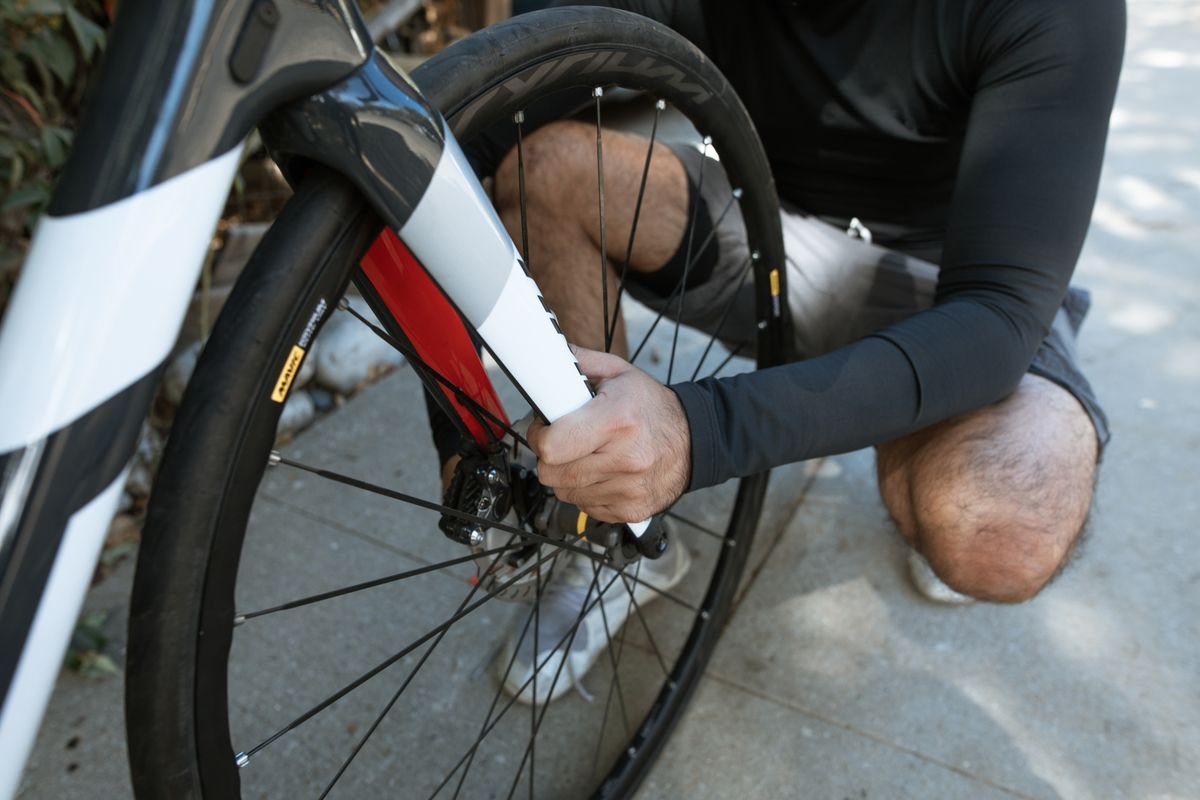
For levers we looked for rim-safe materials, real strength at the pry point and shapes that catch tight beads. For inflators we prioritized reliable seals, controllable flow and broad cartridge compatibility. Everything here is small enough for a seat bag and cheap enough that there is no excuse to ride without it.
Levers and CO2: what to know before you buy
Carry two or three levers; tight tubeless tires often need all of them. A 16g cartridge fills a road tire to roughly 90-100 psi and a gravel tire to about 40 psi, so match cartridge size to your tires. CO2 leaks through butyl tubes overnight, so top up with a pump when you get home. And always test your inflator once at home: a flat is the wrong time to learn how your head threads on.
How to fix a flat with levers and CO2
Shift to the smallest cog, open the brake if needed and remove the wheel. Let any remaining air out, then press the tire bead into the center channel of the rim all the way around. Hook one lever under the bead and lock it to a spoke, add a second lever a few centimeters away, and slide it around the rim until one side is free. Swap the tube, inflate it just enough to hold shape, and check that no tube is pinched under the bead before seating the tire. Push the last section of bead on with your thumbs, or use a lever carefully if the fit is very tight. Thread the inflator onto the valve, attach the cartridge, and inflate in short bursts while watching the tire seat evenly. Spin the wheel to confirm nothing rubs, and you are rolling again.
Related guide: our Topeak bike accessories guide.
FAQ
Are plastic tire levers safe on carbon rims?
Yes. Quality nylon and composite levers like the ones here are the correct choice for carbon. Never use metal screwdrivers or spoons, which gouge rim walls and can cause failures.
How many CO2 cartridges should I carry?
Two is the standard advice: one for the flat and one for mistakes. A cartridge is single-use, and a failed inflation leaves you walking if you only packed one.
CO2 inflator or mini pump?
Ideally both. CO2 is fast and compact but finite; a mini pump is slow but unlimited. Many riders carry CO2 for race-day speed and a small pump as backup on long solo rides.
Why do my levers keep breaking?
Usually technique. Work the bead into the rim’s center channel all the way around before prying, and take small bites instead of one huge lever movement. If breaks continue, step up to a stiffer lever like the Lezyne Matrix.
Do CO2 cartridges expire?
No. A sealed cartridge holds its charge indefinitely. Store them dry so the steel does not rust, and keep them out of extreme heat in a car.
Can I fly with CO2 cartridges?
Airline rules vary, but most carriers in the US prohibit gas cartridges in carry-on and checked bags. Buy cartridges at your destination instead.
Related guides
Keep these tools in one of the best bike seat bags, and pair them with picks from our guides to the best bike multi-tools, the best bike pumps and the best bike tool kits. If you are setting up an indoor space instead, see the best indoor trainer mats.